How Group Therapy is Becoming the Future of Healing
8 October 2026
For decades, the image of therapy in popular culture has been remarkably consistent. One person. One therapist. A box of tissues. A quiet room. That picture is not wrong, but it is incomplete. While individual therapy remains a powerful and necessary form of treatment, a quieter shift has been taking place in clinics, hospitals, community centers, and online platforms around the world. Group therapy, once treated as a budget alternative or a last resort when resources ran thin, is increasingly being recognized as a distinct and often superior method of healing in its own right.
This is not a passing trend. It reflects a deeper understanding of how human beings actually recover from psychological pain. People heal in relationship, not in isolation. And a well-run therapy group is one of the most efficient, honest, and transformative relational environments we can create.
In this article, I want to explain why group therapy is moving from the margins to the center of modern mental health care. I will cover how it works, when it works best, when it can fail, and what anyone considering it should understand before walking into a room full of strangers.

Why Individual Therapy Was Never the Whole Story
Individual therapy is built on a private contract. You speak, the therapist listens, and whatever happens in that room stays there. That privacy is valuable. It creates safety, allows for deep personal disclosure, and gives the therapist full attention to direct at one person.But it also has limits that are easy to overlook.
First, individual therapy is expensive. A single session can cost more than a full month of group sessions in many settings. That cost limits how often people can attend, how long they can stay in treatment, and who can access it at all.
Second, individual therapy happens in a social vacuum. You can talk about your marriage, your friendships, or your fear of conflict for months without ever testing those skills in a live relational setting. Insight grows, but practice does not.
Third, and this is the part that matters most, human suffering is often relational in origin. People are hurt by other people. They are neglected, criticized, bullied, abandoned, or misunderstood by others. It makes sense that healing might also need to happen with others.
Group therapy addresses all three of these gaps. It is cheaper, it is live, and it is inherently social.

What Group Therapy Actually Is
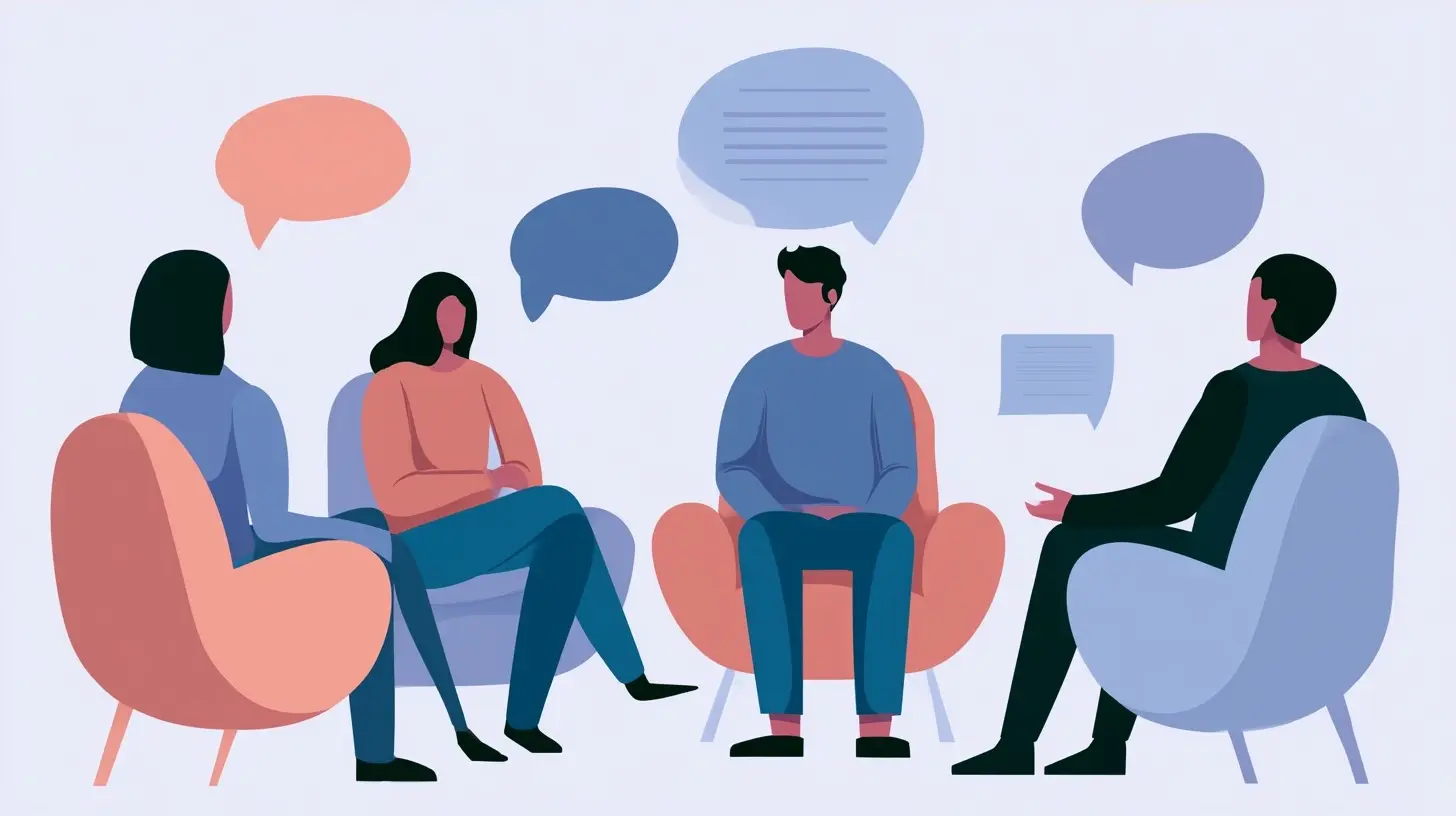
Group therapy is not a support group, though the two are often confused. A support group is typically peer-led and focused on mutual encouragement. Group therapy is led by a trained clinician and uses the group itself as the primary tool of change.There are several major types.
Process-Oriented Groups
These groups focus on what happens in the room. Members talk about their lives, but the therapist also pays attention to how members relate to each other in real time. If someone is quiet, that silence becomes part of the work. If two members clash, that clash becomes material. The group becomes a live laboratory for understanding how you show up in relationships.Cognitive Behavioral Groups
These are more structured. Members learn specific skills, such as identifying distorted thoughts, challenging avoidance, or building exposure plans. Sessions often follow a curriculum. This format works well for anxiety, depression, insomnia, and phobias.Psychoeducational Groups
These groups teach. They might cover emotion regulation, communication skills, or the biology of trauma. They are often used in hospitals, schools, and outpatient programs. The therapeutic value comes from knowledge plus group discussion.Skills-Based and Theme-Based Groups
Examples include dialectical behavior therapy groups, grief groups, anger management groups, and groups for people with chronic illness. The theme gives the group focus, and the shared experience creates a particular kind of trust.Each format has trade-offs. Process groups tend to produce deeper change but take longer and require more skilled facilitation. Skills groups produce faster symptom relief but may not address underlying relational patterns. The best programs often combine both.
The Science of Why Groups Work
The therapeutic power of groups is not a mystery. It rests on several well-documented mechanisms.Universality
When you sit in a room and hear someone describe a thought you believed was yours alone, something shifts. Shame depends on secrecy. Groups break secrecy. This is why groups for grief, addiction, trauma, and chronic illness can feel like relief within the first session.Altruism
Helping others is itself therapeutic. When a group member offers comfort or insight to someone else, they experience themselves as capable and valuable. That experience directly contradicts the self-image of many people in treatment, who often see themselves as burdens.Interpersonal Learning
This is the core of process groups. You learn how you affect others by watching their reactions. You learn how you misread people by hearing their actual thoughts. You learn that conflict does not have to destroy a relationship. These lessons are difficult to acquire in individual therapy because there is only one other person in the room, and that person is paid to be patient with you.Instillation of Hope
Seeing someone further along in recovery is one of the most reliable predictors of engagement in treatment. Hope is contagious in a group in a way it cannot be in a one-on-one session.Modeling
Members learn from each other. A person who has never seen healthy confrontation can watch someone else do it and survive. A person who has never asked for help can watch someone else ask and receive it.Corrective Emotional Experience
This term, coined by psychiatrist Franz Alexander, describes what happens when a person re-experiences an old emotional situation but with a new outcome. If you grew up being ignored when you were upset, and a group turns toward you when you cry, the old wiring begins to loosen.None of these mechanisms require expensive technology or exotic techniques. They require a group.

Why Group Therapy Is Gaining Ground Now
Several forces are converging to push group therapy toward the center of care.The Access Crisis
Demand for mental health services has risen sharply, while the supply of clinicians has not kept pace. Waiting lists are long. Group therapy allows one clinician to treat eight or ten people at once. That efficiency is not a compromise. It is a structural advantage.The Loneliness Epidemic
Loneliness is now widely recognized as a serious health risk, comparable in some studies to smoking. Individual therapy can unintentionally reinforce isolation. Group therapy directly counters it. People in groups form relationships. Some of those relationships outlast the group itself.Cost Pressure
Insurance systems and public health programs are increasingly favoring treatments that produce good outcomes at lower cost. Group therapy fits that description. Many clinic directors now view it as a first-line option rather than a fallback.Digital Delivery
Online group therapy has expanded access dramatically. People in rural areas, people with mobility challenges, and people who feel too ashamed to walk into a clinic can now join a group from home. Platforms designed for secure video conferencing have made this practical. The trade-off is real, which I will discuss later, but the reach is undeniable.Growing Recognition of Social Determinants
Mental health research increasingly emphasizes that healing does not happen in a vacuum. Housing, community, and belonging matter. Group therapy is one of the few clinical interventions that directly builds belonging.What a Good Group Looks Like
Not all groups are created equal. A poorly run group can be boring, chaotic, or even harmful. A well-run group has several recognizable features.Clear Structure
Members know how long the group lasts, how often it meets, what the rules are, and what is expected of them. Ambiguity breeds anxiety.Strong Screening
Good facilitators screen members before they join. They look for fit, readiness, and risk. A person in acute crisis may not be a good candidate for a process group. A person who is actively violent or unable to respect boundaries should not be placed in a group without careful planning.Consistent Leadership
Groups work best when leadership is stable. Frequent changes in facilitators disrupt the group's sense of safety.Ground Rules That Are Actually Enforced
Confidentiality, no interrupting, no advice-giving unless asked, no physical aggression, no outside contact without consent. These rules are not bureaucratic. They create the safety that allows risk.Attention to Process
A skilled facilitator notices what is happening between members, not just what they are saying. They might say, "I notice you looked away when she mentioned her father." That single observation can open more than an hour of content.Balanced Participation
In healthy groups, no single member dominates. Facilitators actively work to bring quieter members in and to gently limit those who monopolize time. This is one of the hardest skills to learn.
Real-World Examples
Consider a man in his forties who has struggled with depression for years. In individual therapy, he is articulate and insightful. He understands his childhood, his triggers, and his patterns. Yet he remains isolated. He does not call friends. He does not date. His therapist suggests a process group.In the group, he is initially silent. Over weeks, he begins to speak. Then something happens. Another member tells him that he seems distant. He feels accused. He wants to leave. The facilitator asks him to stay with the feeling. He does. Another member says she felt the same way when she first joined. The group does not collapse. He comes back the next week. Over months, he starts to risk more outside the group.
This kind of change is difficult to produce in individual therapy because the therapist is not a peer. The group provides something the therapist cannot: a room full of people who are not paid to be there.
Now consider a different example. A young woman with panic disorder joins a cognitive behavioral group. She learns breathing techniques, cognitive restructuring, and interoceptive exposure. She practices in session with other members. She hears others describe the same terrifying sensations. Within twelve weeks, her panic attacks drop significantly. She also reports that the group made her feel less like a freak.
These two examples illustrate different mechanisms and different timelines. Both are valid.
When Group Therapy Is the Better Choice
Group therapy is often the better choice when:- The person's difficulties are primarily interpersonal.
- The person feels isolated or ashamed.
- Cost or access is a barrier to frequent individual sessions.
- The person has already made progress in individual therapy and needs practice.
- The person benefits from structure and accountability.
- The person wants to hear from others with similar experiences.
When Individual Therapy Is Still Better
Group therapy is not universally superior. Individual therapy is often better when:- The person is in acute crisis or at risk of self-harm.
- The person has severe social anxiety or paranoia that makes group participation impossible at first.
- The person needs to disclose something they are not ready to share with peers.
- The person requires a highly specialized treatment that few groups offer.
- The person's schedule does not match available groups.
- The person has a history of being bullied or scapegoated in groups.
In practice, many people benefit from both. A common arrangement is individual therapy every other week plus a weekly group. The individual sessions address personal material; the group addresses relational patterns.
Common Mistakes and Misconceptions
Misconception One: Group Therapy Is Cheaper Because It Is Worse
This is false. Group therapy is cheaper because it is more efficient, not because it is inferior. In many outcome studies, group therapy performs comparably to individual therapy for depression, anxiety, and trauma. The difference is in mechanism, not quality.Misconception Two: Groups Are Just People Complaining
A well-run group is not a complaint circle. It is a structured environment with a leader who directs attention, interrupts unhelpful patterns, and keeps the work moving.Misconception Three: My Problems Are Too Unique for a Group
This belief is almost universal among newcomers. It is also almost always wrong. The specifics of your life are unique. The emotional patterns are not.Misconception Four: I Will Be Forced to Talk
Good facilitators do not force disclosure. They invite it. You can participate at your own pace. That said, silent members often struggle to benefit. If you never speak, the group cannot work with you. A middle path is usually best: speak when you can, and let the facilitator know if you need time.Mistake One: Joining a Group That Is Wrong for You
Not every group fits every person. A trauma group may be too intense for someone who is still in an unsafe living situation. A process group may be too unstructured for someone who needs skills first. Screening exists to prevent these mismatches. Take it seriously.Mistake Two: Treating the Group as a Social Club
Groups can produce friendships, but that is not the primary purpose. When members prioritize socializing over therapeutic work, the group loses its edge. Facilitators often address this directly.Mistake Three: Breaking Confidentiality
This is the most serious violation. What is said in the group stays in the group. Even mentioning that you saw another member at the grocery store can be a breach if you reveal that you know them from therapy. Good groups discuss this openly in the first session.Mistake Four: Quitting Too Soon
Many people leave a group after two or three sessions because it feels uncomfortable. Discomfort is often a sign that the work is happening. A reasonable commitment is at least eight to twelve sessions before deciding whether the group is helping.
How to Choose a Group
If you are considering group therapy, ask these questions.Who Leads It?
Is the facilitator licensed or supervised? What is their training in group work? Group facilitation is a specific skill, not something every therapist does well. Ask about their experience.What Is the Format?
Is it process-oriented, skills-based, psychoeducational, or a hybrid? How long does it run? How many members?Who Else Is in It?
Are members screened for fit? Is the group homogeneous or mixed? Some people do better in a group with others who share their experience. Others prefer diversity.What Are the Rules?
Confidentiality, attendance, outside contact, substance use before session, and screen behavior in online groups. Clear rules are a sign of a well-run group.What Is the Cost?
Group therapy is usually significantly cheaper than individual therapy, but it is not always free. Ask about sliding scales and insurance.What Is the Exit Plan?
How do members leave the group? A good group plans for endings. Abrupt departures can harm remaining members.The Online Group Question
Online group therapy has expanded access, but it comes with trade-offs.Advantages include convenience, no commute, access to specialized groups regardless of location, and reduced stigma for people who fear being seen entering a clinic.
Disadvantages include technical problems, difficulty reading body language, risk of distraction at home, and privacy concerns if the person does not have a private space. Some people find it harder to feel connected through a screen. Others find it easier because they feel less exposed.
The best online groups use secure platforms, require cameras on, establish clear rules about location and privacy, and build in extra time for connection. If you are considering an online group, ask how the facilitator handles disruptions, confidentiality, and crisis situations.
What the Future Likely Holds
Group therapy is not going to replace individual therapy. It is going to sit beside it, and in many settings, it will come first.Several developments are likely.
Integration with Digital Tools
Groups may be supplemented with apps for between-session practice, mood tracking, and homework. The group remains the core, but the tools extend its reach.Hybrid Models
Some programs may combine occasional in-person intensives with weekly online sessions. This preserves the power of face-to-face contact while reducing barriers.Better Training
As demand grows, training programs are likely to place more emphasis on group facilitation. This is overdue. For too long, group work has been treated as something any therapist can do without specific training. That assumption has produced many mediocre groups.Wider Use in Medical Settings
Groups are already used in pain management, oncology, diabetes care, and cardiac rehabilitation. Expect more of this. The evidence for group-based psychosocial support in chronic illness is strong.Greater Attention to Diversity
Groups must be led with cultural awareness. What counts as respectful participation, appropriate disclosure, or healthy confrontation varies across cultures. Good facilitators adapt. This is an area where the field continues to grow.Practical Advice for Anyone Considering a Group
Start by asking yourself what you want. If you want insight into your past, individual therapy may be the better first step. If you want to change how you relate to people, a group is often the faster route.Be honest during screening. If you are not ready to speak in front of others, say so. A good facilitator will help you decide whether to wait, prepare, or try a different format.
Commit for a set period. Give the group at least two months before you judge it. The first few sessions are almost always awkward.
Speak up when something bothers you. The group is a place to practice exactly that. If another member irritates you, that irritation is useful material. Bring it to the group rather than letting it fester.
Respect the rules. They exist for a reason. Confidentiality protects everyone, including you.
Ask for what you need. If you want more time, say so. If you want feedback, ask. If you need to sit quietly one week, that is allowed, but let the group know.
Notice your patterns. The way you behave in the group is likely the way you behave outside it. That is the whole point.
A Balanced View
Group therapy is not magic. It can be poorly led, poorly attended, or poorly matched to a person's needs. It can feel exposing. It can be frustrating. Some people try it and decide it is not for them, and that is a legitimate outcome.But when it is done well, it offers something that individual therapy rarely can: a room full of people who are also working, also struggling, and also changing. That shared reality is powerful. It breaks shame. It builds skills. It creates belonging.
The future of healing is not a single format. It is a range of options matched to the person and the moment. Group therapy is becoming central because it addresses something fundamental about human beings. We are social creatures. We are wounded in relationship. We heal in relationship too.
If you have been circling the idea of therapy and wondering whether a group might be right for you, the answer is probably worth finding out. Ask a clinician. Ask about the group's format, leader, and rules. Then give it a fair chance. You may find that the room full of strangers becomes the place where something finally shifts.
all images in this post were generated using AI tools
Category:
Healing TechniquesAuthor:

Ember Forbes
Discussion
rate this article
1 comments
Poppy McKinley
Group therapy fosters connection and shared experiences, allowing participants to gain insights from one another. This collective healing approach can enhance individual progress and promote lasting change.
October 8, 2026 at 2:35 AM