The Fine Line Between Optimism and Emotional Denial
23 October 2026
There is a particular kind of person who, when you tell them something difficult is happening, responds with a bright smile and the words "everything happens for a reason." Sometimes that person is genuinely wise and grounded. Sometimes that person is you, and you are not okay. Telling the difference between healthy optimism and emotional denial is one of the most useful psychological skills a person can develop, and most of us were never explicitly taught it.
Both optimism and denial can look identical from the outside. Both involve a forward-looking posture. Both can produce calm in the face of bad news. But they operate through completely different mechanisms, and they lead to very different long-term outcomes. Optimism is a way of engaging with reality. Denial is a way of avoiding it. The tricky part is that denial often feels like optimism from the inside, which is why so many thoughtful people get confused about which one they are practicing.
This article unpacks that confusion in practical terms. It covers what each state actually is, why the distinction matters, how to tell them apart in yourself and others, and how to build the kind of optimism that holds up under pressure without slipping into avoidance.

What Optimism Actually Is, Psychologically
Optimism, in the research sense, is not the belief that everything will be fine. It is a set of expectations about outcomes combined with a particular way of explaining setbacks. The most useful framing comes from the work on explanatory style, which looks at how people interpret negative events along three dimensions: whether the cause is permanent or temporary, whether it is pervasive or specific, and whether it is personal or external.An optimistic explanatory style treats setbacks as temporary, specific, and at least partly outside one's control. A pessimistic style treats them as permanent, pervasive, and personal. Notice that neither style denies that the setback happened. The event is fully acknowledged. The difference lies in what the person believes it means and how long they expect it to last.
This is why genuine optimism is compatible with grief, anger, and fear. You can feel all of those things and still hold the belief that the situation is workable and that your efforts matter. Optimism is not the absence of difficult emotions. It is the presence of a belief that difficult emotions and difficult circumstances are survivable and changeable.
There is also a motivational component. Optimism tends to increase persistence, because if you believe your actions can influence outcomes, you keep taking actions. That persistence, in turn, produces more positive outcomes, which reinforces the belief. It is a feedback loop, and it is one of the reasons optimism correlates with better health behaviors, stronger relationships, and more effective problem-solving.
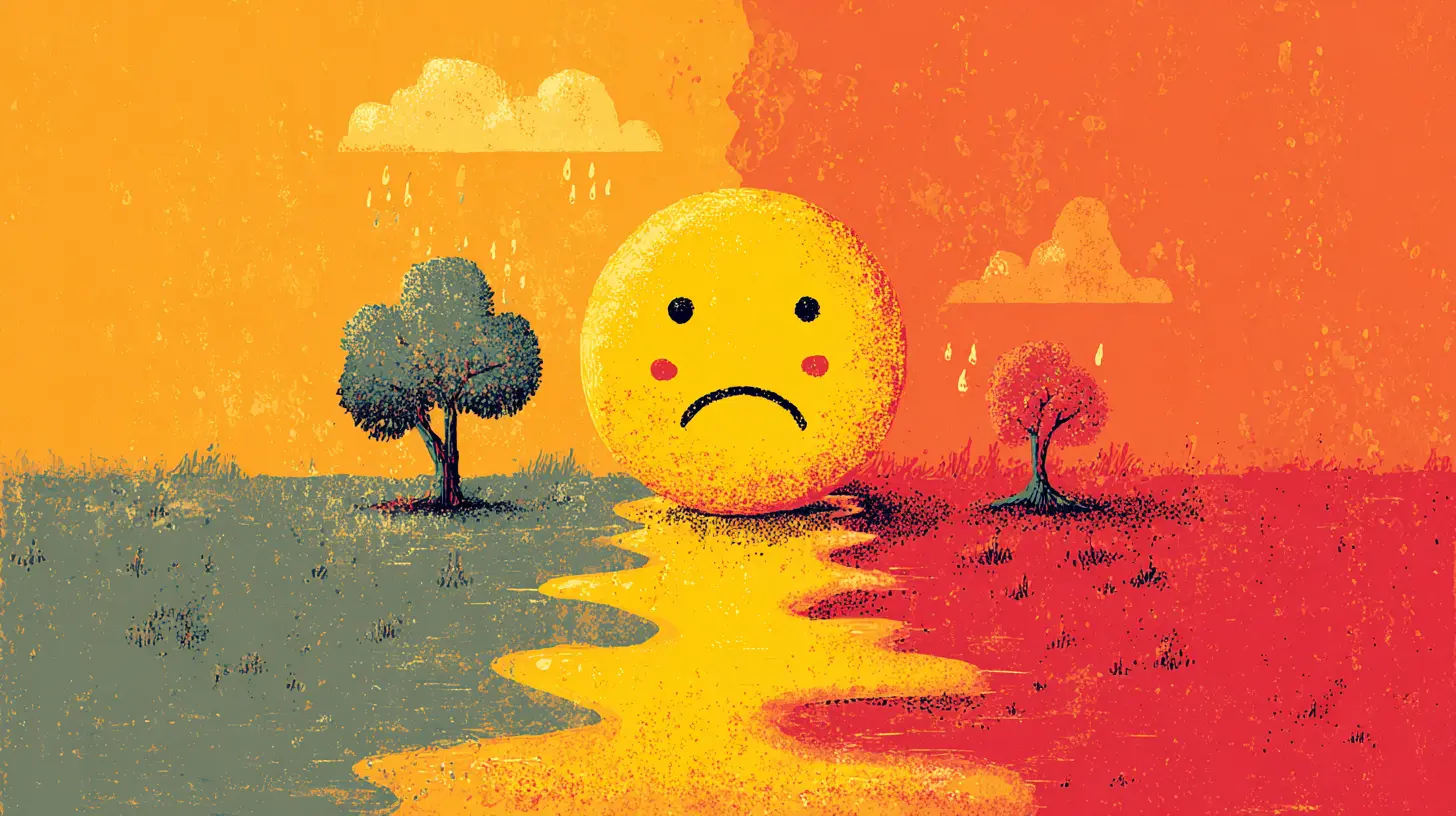
What Emotional Denial Actually Is
Denial is a defense mechanism. In its classic form, it involves refusing to accept a reality that is too threatening or painful to integrate. It is not the same as lying, because the person doing it usually is not consciously aware of the distortion. The mind simply routes around the information.Denial shows up in many forms. Sometimes it is literal: refusing to acknowledge a diagnosis, a failing relationship, or a financial problem. More often it is subtler. It can look like minimizing ("it is not that bad"), reframing too quickly ("this is actually a blessing"), or converting pain into productivity ("I will just throw myself into work"). It can also look like forced positivity, where a person insists on the bright side of every situation so relentlessly that no other perspective is permitted.
The key feature is not the content of the thought but its function. Denial exists to keep something out of awareness. When a person insists that everything is fine in a way that prevents them from processing, adapting, or seeking help, that insistence is doing defensive work, even if it sounds upbeat.
Denial is not always harmful in the short term. In acute crises, a brief period of denial can function as a buffer, giving the nervous system time to mobilize before confronting something overwhelming. The problem arises when the buffer becomes the permanent residence.

Why the Two Get Confused
The confusion is structural. Both optimism and denial can produce a calm exterior. Both can involve positive statements. Both can be socially rewarded, because people generally prefer upbeat company to distressed company.There is also a cultural layer. Many workplaces, families, and social circles reward relentless positivity and punish expressions of difficulty. In those environments, denial gets reinforced as a virtue and genuine emotional processing gets labeled as negativity. A person who says "I am struggling and I am not sure this will work out" may be told to "stay positive," which subtly teaches them that acknowledging pain is a failure of attitude. Over time, that person may learn to skip the acknowledgment entirely and go straight to the bright side, which is exactly the pattern that produces denial dressed up as optimism.
There is a cognitive trap as well. Optimism and denial both involve a gap between current reality and expected outcome. In optimism, the gap is bridged by a plausible belief in agency and change. In denial, the gap is bridged by simply not looking at the current reality. From the inside, both feel like hope. The difference is whether the hope is anchored to anything.

How to Tell Them Apart in Yourself
The most reliable way to distinguish the two is to check what happens when you try to sit with the difficult feeling. Genuine optimism can tolerate the feeling. You can acknowledge sadness, fear, or disappointment and still hold your hopeful view. Denial cannot. When the feeling gets close, denial produces an urgent need to reframe, distract, reassure, or change the subject.Here are some practical self-checks.
The "what if it does not work out" test
Ask yourself, honestly, what you would do if the thing you are hopeful about does not work out. If you can describe a plan, a feeling, and a next step, you are probably in the realm of optimism. If the question itself feels intolerable, or if your mind immediately redirects to reasons it will definitely work out, that is a signal that something is being kept at a distance.The "who can I say this to" test
Optimism can be spoken aloud to a trusted person without needing to be managed. Denial often requires an audience that will not challenge it. If you find yourself only sharing your hopeful framing with people who will agree, and avoiding the ones who might ask hard questions, that is worth noticing.The body check
Denial tends to produce a kind of tension that does not match the words. You say you are fine, but your shoulders are up, your jaw is tight, your sleep is off. Optimism can coexist with a settled body, even when circumstances are hard. The body is often a more honest reporter than the narrative.The repetition check
If you find yourself repeating the same reassuring phrases, especially in response to the same recurring worry, that repetition is doing work. Genuine optimism does not need to be rehearsed. It is a stance, not a script.How to Tell Them Apart in Others
With other people, the signals are behavioral. A genuinely optimistic person can hear bad news without becoming defensive. They can hold space for someone else's pain without rushing to fix it. They can acknowledge uncertainty. They can say "I do not know" without distress.A person in denial often cannot. They may interrupt expressions of difficulty with reassurance, which feels supportive but functions as a shutdown. They may become irritable when someone persists in describing a problem. They may treat any acknowledgment of risk as a personal attack on their hope. They may also become unusually invested in other people adopting their positive framing, because a shared belief is easier to maintain than a solitary one.
It is worth saying clearly: you cannot diagnose denial in someone else with certainty, and you should not try to force them out of it. Denial usually loosens when a person feels safe enough to look at what they have been avoiding. Confrontation tends to tighten it.
The Costs of Getting It Wrong
When optimism is actually denial, several things tend to happen.Problems get worse because they are not being addressed. A health symptom that is minimized goes undiagnosed. A relationship issue that is reframed as a phase compounds. A financial strain that is treated as temporary becomes a crisis.
Emotional processing gets delayed, and delayed processing tends to be more intense when it finally arrives. People who hold off grief for years often find it returns with interest.
Support becomes harder to access, because the person in denial often presents as fine, and the people around them take that presentation at face value. The help that would have been useful early becomes harder to ask for later.
There is also a relational cost. People close to someone in denial often feel unseen, because their own worry is not permitted in the shared space. Over time, that can erode closeness.
When optimism is genuine, the costs are different and much smaller. You may still be wrong about an outcome, but you will have stayed engaged with reality along the way, which means you will adapt faster when the situation changes.
The Middle Path: Realistic Optimism
The most robust stance is what researchers sometimes call realistic optimism or optimistic realism. It combines a clear-eyed assessment of the current situation with a belief that effort and adaptation can improve things. It does not require you to feel good about a bad situation. It requires you to keep both the bad situation and your agency in view at the same time.A realistic optimist facing a job loss might say something like: "This is genuinely bad. I am scared about money. I also know I have skills, a network, and a track record of figuring things out. I do not know how long this will take, and I am going to start today." That statement contains fear, uncertainty, and hope, all in the same breath. That is the signature of the healthy version.
Compare that to the denial version: "This is actually a great opportunity. Everything happens for a reason. I am not worried at all." The second statement may sound more positive, but it leaves no room for the fear, no plan, and no acknowledgment of the real difficulty. It is less resilient, not more.
Practical Steps to Build Genuine Optimism
Name the difficult thing first
Before you reframe, describe. Say out loud or in writing what is actually happening, without softening it. "I am behind on rent." "My father is sick." "This project is failing." Naming it does not make it worse. It makes it workable.Separate the event from the meaning
A setback is an event. The meaning you assign to it is a choice, even when it does not feel like one. Practice generating multiple possible meanings, including the pessimistic one, and notice which ones are supported by evidence. This is not about forcing a positive interpretation. It is about refusing to let the first interpretation be the only one.Keep a small action in view
Optimism stays honest when it is tied to something you can do. It does not have to be big. One phone call, one conversation, one hour of focused work. Action is what distinguishes hope from wishful thinking.Let the feeling have its time
Schedule unstructured time to feel what you feel, especially if you are prone to converting pain into productivity. Journaling, walking, talking to a trusted friend, or sitting with a therapist all count. The goal is not to wallow. The goal is to make sure the feeling is being processed rather than stored.Watch for the reframe reflex
Notice how quickly you move from "this hurts" to "but here is the bright side." Speed is the tell. If the reframe arrives before the feeling has been felt, it is probably doing defensive work. Slow it down. Let the feeling land first.Build a reality-checking relationship
Find at least one person who will tell you the truth and who you will let tell you the truth. This is harder than it sounds, because denial often selects for audiences that will not push back. A good reality-checker is not harsh. They are steady. They can say "I hear your hope, and I also want to make sure you are seeing this clearly" without it feeling like an attack.Distinguish between accepting and approving
Many people resist acknowledging difficulty because they fear that acknowledgment equals surrender. It does not. You can fully accept that something is happening without approving of it or giving up on changing it. Acceptance is a precondition for effective action, not a replacement for it.Common Misconceptions
"Positive thinking is always good." Positive thinking is useful when it is accurate and action-oriented. When it is used to override reality, it becomes a liability. The research on forced positivity suggests that suppressing difficult emotions tends to backfire, increasing stress rather than reducing it."If I acknowledge how bad things are, I will fall apart." Most people are more resilient than they expect. Acknowledging difficulty usually produces a temporary dip followed by more clarity and energy, not a collapse. The collapse that people fear is more often the result of prolonged suppression than of honest acknowledgment.
"Optimism means never being negative." Optimism is not the absence of negative emotion. It is a relationship with negative emotion that allows it to exist without taking over. The most optimistic people you know are often the ones most willing to talk about what is hard.
"Denial is just lying to yourself." Denial is usually unconscious. People in denial genuinely believe their own framing. That is why confrontation rarely works and why safety and time matter more than argument.
"If I feel okay, I must be in denial." Not necessarily. Feeling okay after a hard event can be genuine integration. The question is whether the okay feeling is flexible. Can you also feel sad when something reminds you? Can you talk about the event without needing to control the conversation? Flexibility is the marker, not the presence of calm.
When to Seek Support
If you notice that you cannot tolerate difficult feelings without immediately reframing or distracting, if you find yourself avoiding people who might ask hard questions, or if you suspect that a pattern of relentless positivity is costing you clarity, talking to a therapist can help. Therapy is particularly useful for this because it provides a space where the reframe reflex is gently interrupted and where difficult material can be approached at a tolerable pace.The same applies if you are close to someone who seems to be in denial and you are unsure how to support them without colluding or confronting. A therapist can help you find the middle ground.
A Closing Thought
Optimism and denial are close neighbors, and the fence between them is made of small, unglamorous habits: naming what is hard, letting feelings land, staying in contact with people who will tell you the truth, and keeping one honest action in view. None of those habits feel dramatic. All of them are what make hope durable.The goal is not to become someone who never feels afraid or sad. The goal is to become someone whose hope can survive contact with reality. That kind of hope is quieter than the forced version, and it holds up much better when life gets difficult.
all images in this post were generated using AI tools
Category:
Toxic PositivityAuthor:

Ember Forbes