How Emotional Maturity Redefines Success by 2026
13 September 2026
For most of the industrial and post-industrial era, success has been measured with a fairly narrow set of instruments. Income. Title. Market share. Follower count. These metrics share one trait: they are externally verifiable. Someone else can count them, rank them, and compare yours against theirs. That made them convenient for organizations, institutions, and the broader culture that needed a common scoreboard.
But a scoreboard only works if the game stays the same. And the game is changing.
By 2026, the conditions that produced the traditional success scoreboard will have shifted enough that the scoreboard itself starts to malfunction. Automation absorbs more routine cognitive work. Remote and hybrid arrangements dissolve the physical cues that once signaled status. Career paths fragment into portfolios of shorter engagements. Public trust in institutions continues to erode. And a generation that watched burnout get rewarded with a plaque is entering its prime working years with a different set of priorities.
In that environment, emotional maturity stops being a soft skill that helps you get along with colleagues. It becomes the operating system for navigating ambiguity, sustaining relationships across distance, and making decisions when the old metrics no longer predict outcomes. This article examines why that shift is happening, what emotional maturity actually consists of, how it redefines success in concrete terms, and what you can do to build it deliberately rather than hoping it accumulates on its own.

Why the Traditional Definition of Success Is Losing Predictive Power
For decades, the formula was legible. Get credentials. Get a job at a stable company. Climb. Accumulate. Retire. The formula worked well enough that people could defer emotional development indefinitely. You could be reactive, defensive, and poor at conflict, and still succeed if you hit the right metrics. The system tolerated it because the system rewarded output, not self-awareness.Three structural changes are breaking that tolerance.
First, work is becoming more collaborative and less hierarchical in the ways that matter. Cross-functional teams, matrixed reporting, and project-based work mean you constantly negotiate with people who are not your boss and cannot be ordered around. Influence replaces authority as the primary currency. Influence depends almost entirely on how you handle disagreement, feedback, and uncertainty.
Second, careers are becoming less linear. The average tenure at a single employer has been shrinking for years, and portfolio careers, freelancing, and repeated reskilling are becoming normal rather than exceptional. A linear career rewards patience and loyalty. A portfolio career rewards adaptability, self-regulation, and the ability to rebuild trust quickly with new people. Those are emotional capacities, not technical ones.
Third, the metrics themselves are becoming gameable and therefore less meaningful. When everyone can inflate their numbers, the numbers stop distinguishing anyone. What remains scarce is judgment, composure under pressure, and the ability to work with people who are difficult, different, or both.
There is a fourth factor that gets less attention: the cost of getting it wrong has gone up. A single impulsive email, a public outburst, a badly handled conflict can now travel across an entire industry in hours. Emotional maturity used to be a nice-to-have because mistakes were contained. Now they are permanent and searchable.

What Emotional Maturity Actually Means
The phrase gets used loosely, so it is worth being precise. Emotional maturity is not the absence of emotion. It is not stoicism, positivity, or conflict avoidance. It is a set of capacities that let you feel what you feel without being run by it.The Core Capacities
Affect regulation. The ability to notice an emotional state, tolerate its intensity, and choose a response rather than discharge it immediately. This does not mean suppressing anger or grief. It means the emotion does not get to make decisions on your behalf.Perspective-taking. The ability to hold your own view as one interpretation among several, without collapsing into relativism. You can be confident and still curious. You can disagree and still understand why the other person sees it differently.
Distress tolerance. The capacity to sit with discomfort, uncertainty, and unresolved problems without needing to force closure. Most important decisions happen in conditions of incomplete information. People who cannot tolerate that vacuum tend to make premature, often worse, choices.
Accountability without self-destruction. Owning a mistake fully without either deflecting it or turning it into a prolonged self-flagellation that makes you useless to everyone around you. This is harder than it sounds because our culture offers only two scripts: blame outward or shame inward.
Empathy with boundaries. Understanding another person's experience without absorbing responsibility for fixing it. Empathy without boundaries becomes codependency. Boundaries without empathy becomes coldness. Maturity is holding both.
What Emotional Maturity Is Not
It is not conflict avoidance dressed up as calm. Many people who describe themselves as "not confrontational" are actually conflict-avoidant, which means problems fester and relationships quietly degrade. Maturity often looks like having the difficult conversation earlier, not later.It is not relentless positivity. Toxic positivity is a defense mechanism that protects the person expressing it from having to sit with someone else's pain. It is frequently experienced by the recipient as invalidation.
It is not the same as being nice. Some of the most emotionally mature people are quite direct. They have simply learned to be direct without being cruel.
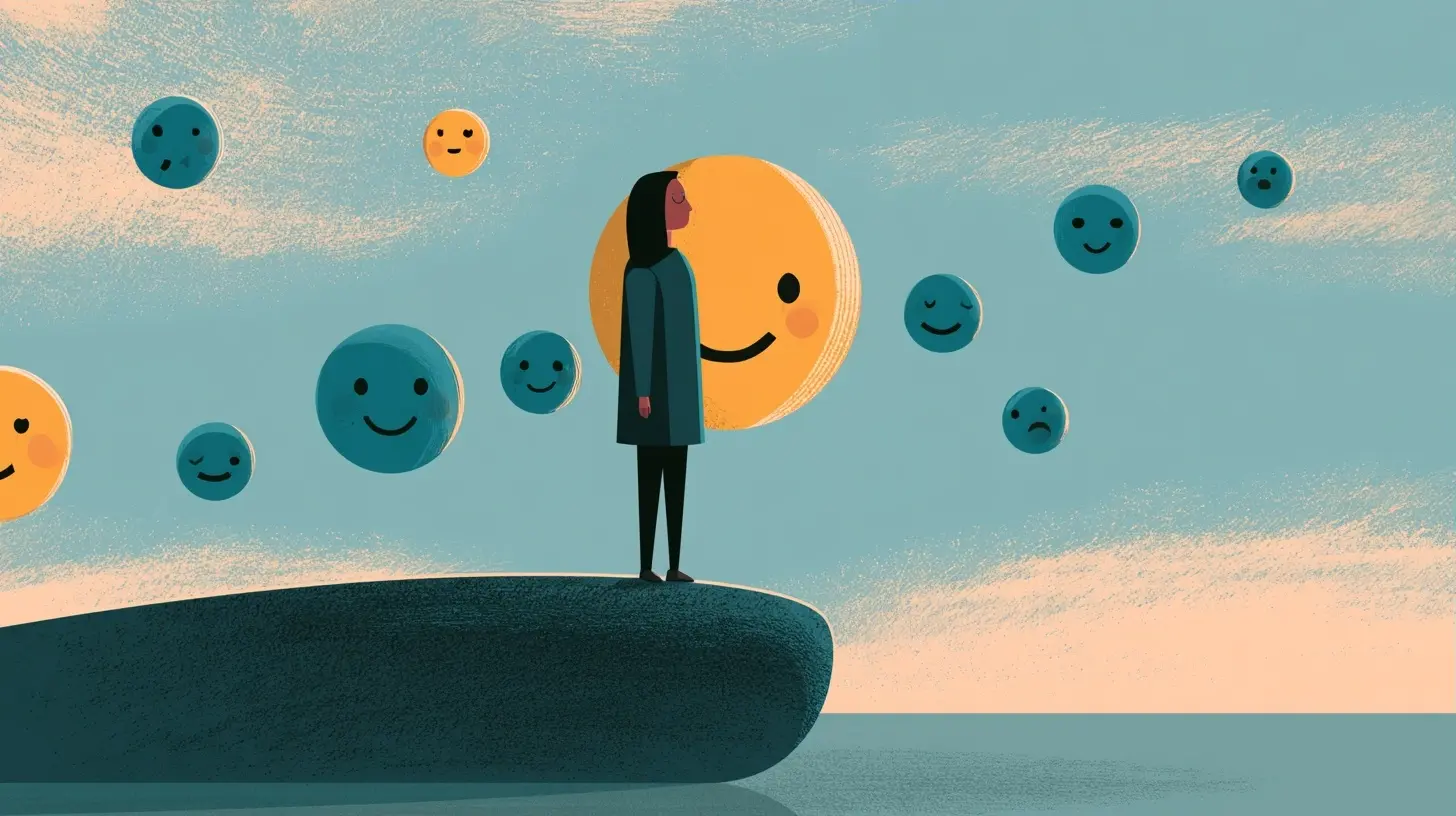
How Emotional Maturity Redefines Success in Practice
The redefinition is not abstract. It shows up in how people define their goals, evaluate their days, and make trade-offs.From External Validation to Internal Coherence
Traditional success asks: what do others see? Mature success asks: does my life hold together on its own terms? This is not a rejection of ambition. It is a shift in where the anchor sits. When your sense of worth depends on external validation, you become vulnerable to every fluctuation in how others perceive you. That vulnerability is expensive. It produces decisions that look good on paper and feel wrong in the body.Consider two managers with identical performance reviews. The first feels good for a week and then starts worrying about the next cycle. The second feels good, notices the feeling, and uses the moment to ask whether the work itself is still meaningful. Over five years, the second manager is more likely to make a career change that actually fits, while the first keeps optimizing for reviews that never quite satisfy.
From Winning Arguments to Solving Problems
People who are emotionally immature treat disagreement as a contest to be won. People who are mature treat it as information to be integrated. This distinction sounds soft, but the practical consequences are significant. In a meeting, the person who needs to be right will often win the point and lose the relationship, the project, or the long-term trust of the room. The person who can say "I might be wrong about this, walk me through your reasoning" tends to end up with better information and stronger alliances.This does not mean capitulating. It means separating the goal (a good outcome) from the ego (being the one who had the good outcome).
From Busyness as Status to Capacity as Status
For a long time, being busy signaled importance. If your calendar was full, you were needed. By 2026, that signal has inverted in many knowledge-work environments. The most valuable people are often the ones with enough space to think, respond thoughtfully, and notice problems before they escalate. Chronic busyness is increasingly read as poor prioritization rather than high value.Emotional maturity supports this shift because it requires the ability to say no without guilt, to disappoint people without crumbling, and to protect unstructured time even when it feels unproductive.
From Resilience as Endurance to Resilience as Recovery
The old story of resilience was about pushing through. Grind. Persist. Outlast. The newer understanding, supported by a growing body of work on stress physiology, is that resilience is less about enduring without breaking and more about recovering quickly after strain. That reframes rest, repair, and relationship maintenance as core to performance rather than rewards for it.Emotionally mature people tend to be better at this because they can notice when they are depleted without interpreting it as weakness.

Common Misconceptions That Hold People Back
Several beliefs about emotional maturity are widespread and wrong. Each one costs people something."Maturity means I stop feeling things intensely." No. It means the intensity no longer dictates your behavior. Many emotionally mature people feel things very strongly. They have simply developed a wider gap between stimulus and response.
"I will develop it naturally with age." Age and maturity correlate weakly. Some people accumulate years without accumulating self-awareness. Without deliberate reflection, feedback, or therapy, most people plateau at whatever level of emotional functioning they reached in early adulthood.
"It is a personality trait, so it is fixed." Emotional maturity is better understood as a skill set. Affect regulation, perspective-taking, and distress tolerance are trainable. They respond to practice, feedback, and structured reflection.
"It is a soft skill, so it is secondary." In environments where technical skills are abundant and easily verified, emotional capacities become the differentiator. They are also the hardest to fake, which makes them a more durable source of advantage.
"Being mature means being calm all the time." Calm is often a presentation. Maturity includes the capacity for appropriate anger, grief, and joy. The goal is not flatness. It is flexibility.
Practical Ways to Build Emotional Maturity
The following practices are not a program. They are components you can adopt selectively based on where you currently struggle. Each one has trade-offs worth understanding.Name the Emotion Before Acting
When you notice a strong reaction, pause and label it. "This is anger." "This is fear of looking incompetent." Labeling does two things: it engages the prefrontal regions involved in regulation, and it creates a small gap between the feeling and the response. The trade-off is that it can feel artificial at first, especially for people who value spontaneity. The benefit is that it prevents the most costly reactions.Separate the Story From the Facts
Emotions come bundled with interpretations. Someone did not respond to your message, and the story is that they are dismissing you. The fact is that they did not respond. Mature people learn to hold the story loosely and check it. This is not about suppressing intuition. It is about distinguishing between what happened and what you concluded.Practice Disagreeing Without Escalating
Most people have two modes: agree or fight. Mature disagreement is a third mode. It sounds like "I see it differently, and here is why" delivered calmly, with curiosity about the other person's reasoning. This is a skill that improves only with repetition. Start with low-stakes disagreements to build the muscle.Solicit Feedback You Do Not Want to Hear
Ask specific people specific questions. Not "how am I doing" but "what is one thing I do that makes your work harder?" Then do not defend. Thank them, sit with it, and decide later what to do with it. The trade-off is that this is uncomfortable and can occasionally surface unfair criticism. The benefit is that it calibrates your self-perception against reality.Build Recovery Into Your Schedule
Resilience is a function of recovery, not endurance. Protect sleep, relationships, and unstructured time with the same seriousness you protect meetings. Emotionally depleted people are not mature, no matter how much they know about maturity. The trade-off is that this can look like lower ambition to people who still equate busyness with value.Get Comfortable With Unresolved Problems
Not every problem needs a solution today. Some need time, more information, or simply to be tolerated. Learning to sit with open loops without anxiety is one of the most underrated mature capacities. It prevents premature decisions and unnecessary conflict.
Trade-Offs and Nuance
Emotional maturity is not a universal good in every context. There are situations where it can be misapplied.In genuinely abusive or exploitative environments, staying calm and perspective-taking can become a form of complicity. Maturity does not mean tolerating mistreatment. Sometimes the mature response is to leave, escalate, or draw a hard line.
In fast-moving crises, extended reflection can cost lives or opportunities. There is a time for deliberation and a time for decisive action. Maturity includes knowing which is which.
In cultures or families where direct emotional expression is valued differently, standard Western frameworks of emotional maturity can misfire. What looks like suppression in one context may be a form of respect in another. Context matters.
Finally, emotional maturity can be weaponized. Some people use therapeutic language to avoid accountability, framing every conflict as the other person's lack of regulation. This is manipulation dressed as growth. Real maturity includes the willingness to be told you are wrong.
What to Watch For by 2026
Several trends will make emotional maturity more consequential in the next few years.As AI tools absorb more routine cognitive work, the human differentiators will concentrate in areas machines handle poorly: judgment, trust-building, navigating ambiguity, and managing relationships. These are all emotional capacities.
As remote and hybrid work persist, the informal signals that once communicated care and respect (a hallway check-in, a shared lunch) will need to be replaced with deliberate practices. Emotionally mature people will be better at this because they can read absence and silence accurately rather than assuming the worst.
As career paths fragment, people will need to rebuild professional trust repeatedly. The ability to enter new environments with curiosity rather than defensiveness will become a career asset in itself.
As public discourse remains polarized, the people who can hold complexity, disagree without dehumanizing, and maintain relationships across difference will be disproportionately valuable in every field.
Conclusion
Success is not becoming less ambitious. It is becoming less naive about what ambition requires. The old scoreboard assumed a stable environment where output could be measured cleanly and relationships were secondary. That environment is receding. What remains, and what will matter more by 2026, is the capacity to stay clear-headed when things are uncertain, to work well with people who are difficult, and to define a life that holds together on its own terms.Emotional maturity is not a personality trait you either have or do not. It is a set of practices you can build, refine, and lose if you stop tending them. The people who treat it as seriously as they treat technical skill will find that it redefines not just how they succeed, but what success even means to them.
all images in this post were generated using AI tools
Category:
Emotional MaturityAuthor:

Ember Forbes
Discussion
rate this article
2 comments
Candice Castillo
The article highlights a crucial shift in how we define success. Emotional maturity will play a key role in future achievements, emphasizing well-being and personal growth over traditional metrics.
September 28, 2026 at 4:03 AM
Roman Heath
Emotional maturity truly reshapes our definition of success.
September 27, 2026 at 4:15 AM